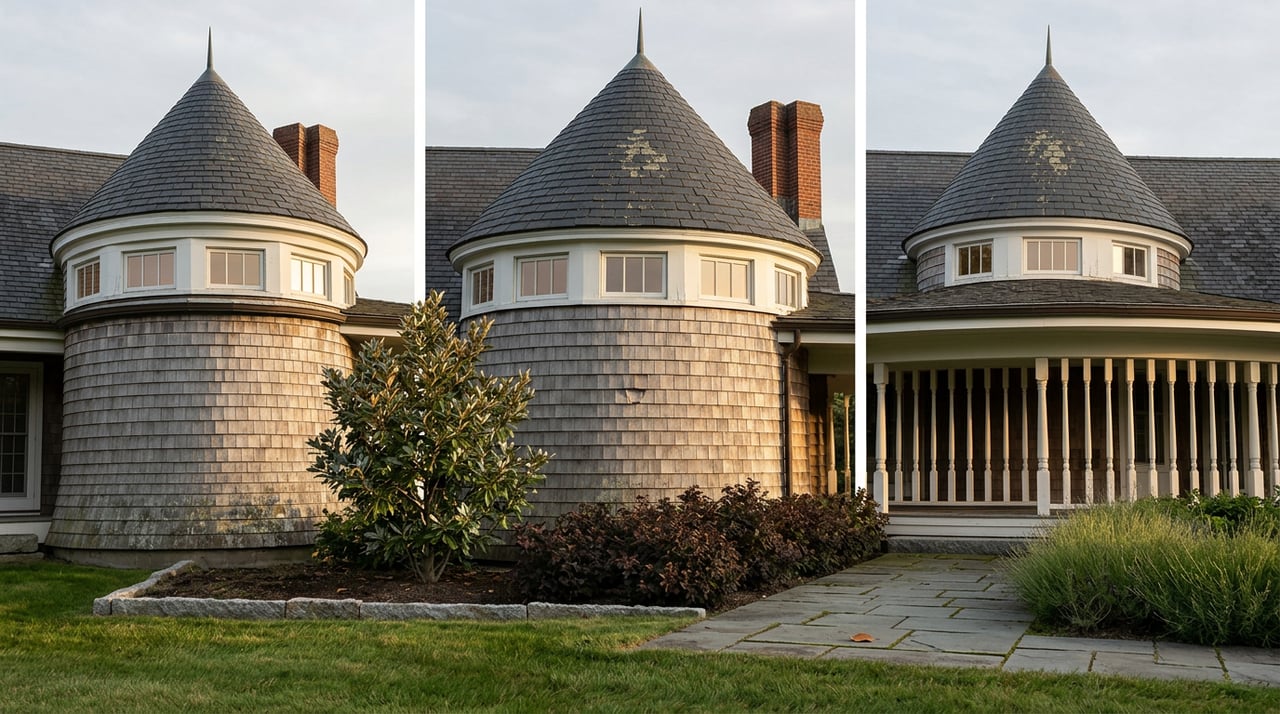
Two waterfront homes changed hands in Jamestown this year, and the listing language tells you almost everything about what separates a serious water-access claim from a hopeful one. The $6.5 million sale of 10 Coulter Street, known as "Bridge View," closed with sweeping bay views and, as Newport Buzz reported, a private mooring included with the property, making it the town's largest residential sale of 2026 through early June. Around the same time, a $2.6 million home on Seaside Drive in the Jamestown Shores neighborhood sold with something softer attached to it: what Providence Business News described as "possible mooring opportunities."
Those two phrases are not interchangeable, and the difference between them is not marketing polish. It is the difference between a reported private mooring and a hope that gets filed in a queue where, as of a February 2024 harbor commission review, some applicants had already been waiting 21 years.
What "Riparian" Actually Buys You
Jamestown manages 1,122 moorings across its harbors, according to figures a Jamestown Press report on a February 2024 harbor commission meeting attributed to Steven Bois, then the harbor division's executive director. Of that total, 452 are commercial moorings tied to marinas and yacht clubs, and 356 are riparian moorings, allocated specifically to waterfront property owners. The remaining 314 are general-use moorings, a quarter of which are set aside for out-of-town boaters, leaving roughly 236 for residents who don't own shorefront property.
A riparian mooring in Jamestown isn't a vague perk. The town's own ordinance, discussed in a 2019 Jamestown Press article on a proposed rewrite of the harbor code, defines a riparian property as a freehold estate of record with shorefront directly adjacent to town waters, and the mooring itself has to sit within the water directly off that property's extended lateral lines. That review happened because the state's Coastal Resources Management Council flagged Jamestown for issuing riparian moorings outside those boundaries for years. In other words, even the "guaranteed" category has geometry attached to it, and the state checks the town's homework.
A Jamestown Press report quoted Bois describing a single case working through the general waitlist:
"I have to give it to him if he's next. The ordinance does not allow me to say 'no.'"
That was about a man at Dutch Harbor seeking his fifth mooring while 69 people below him on the same list were still waiting for their first. Riparian rights don't run into that problem, because they aren't drawn from the same pool.
The Queue on the Other Side of That Word
If a listing doesn't carry riparian rights, "mooring opportunities" means getting in line, and the line has been getting longer. In a 2018 Jamestown Press interview, longtime harbormaster Sam Paterson described the town mooring process as taking anywhere from four to ten years, with 1,117 total moorings in the system at that point. By the time Bois presented his data at the harbor commission's February 2024 review, the picture had shifted: 296 people were on the waitlist for moorings at Dutch Harbor and East Ferry, with some waits stretching to 21 years.
Part of what's stretching the line is that Jamestown places no cap on how many moorings a single person can hold. The same February 2024 report found 60 people already operating more than one mooring, with 42 more on the waitlist seeking an additional one. A separate Jamestown Press account of the harbor commission's February 14, 2024 meeting put the scale of the slack another way: an estimated 90 moorings sat vacant across both harbors for the entire prior season. One harbor commissioner, Mark Campbell, summed up what the queue feels like from the inside:
"I've been on the list for 10 years. I think I moved up two spots."
That's the reality behind "possible mooring opportunities." It isn't a lie. It's just a much longer and less certain path than a property with a reported private mooring.
Jamestown's Ordinance Is the Regional Outlier, and That Changes What a Deed Is Worth
Bois didn't just study Jamestown. He compared its rules against seven other Rhode Island coastal towns, including Narragansett, Charlestown, North Kingstown, New Shoreham, Newport, Westerly, and South Kingstown. Nearly every one of them limits riparian moorings to one per property, or one plus a single guest mooring. Jamestown allows a riparian homeowner up to four.
That gap matters for anyone comparing waterfront value across towns rather than just across listings within one town. A shorefront deed in Jamestown can carry meaningfully more built-in water access than an equivalent deed in most of the surrounding communities, simply because of how the local ordinance was written. It's a detail that never shows up in a price-per-square-foot comparison, but it shows up the first time a buyer tries to put a second or third boat on the water.
What a Mooring Actually Costs in 2026
The dollar figures are modest compared to the real estate itself, which is part of why the access question gets overlooked. A November 2025 Jamestown Press report on the harbor commission's adopted budget, prepared by current executive director James Heagney, put the 2026 residential mooring rate at $5.50 per foot, up from $5.31 in 2025. That follows a decade of flat pricing at $4.60 per foot from 2013 through 2023, then increases of 10 percent in 2024, 5 percent in 2025, and 3.5 percent in 2026, a 19.6 percent climb over three years after a long stretch of stability. The town's total harbor budget for 2026-27 came in at $390,714, a 4 percent increase over the prior year.
Run the arithmetic and the annual cost is almost beside the point: a 25-foot boat costs $137.50 a year at the 2026 resident rate, a 40-foot boat costs $220. The waitlist fee itself, meanwhile, ticked up from $12.70 to $13.00. Nobody is priced out of a mooring by the fee schedule. They're priced out by the wait.
What This Means If You're Comparing Jamestown Listings
When a listing says "riparian rights to a mooring" or "private mooring included," that language is doing real legal work, and it's worth confirming rather than assuming. A buyer evaluating waterfront property here should ask whether the mooring in question is riparian or general-list, whether it's currently registered with the harbor office in the seller's name, and whether the property's shorefront actually falls within the lateral extension that Jamestown's ordinance requires for a riparian designation. None of that shows up in square footage or in a comparable-sales report. It shows up in the harbor office's own records, which is exactly the kind of detail worth verifying before a deposit goes down, not after.
A Short FAQ
What should a buyer confirm before closing? Confirm any mooring details directly with the town before closing.
If a listing doesn't mention mooring rights, can I still apply for one? Yes, through the general waitlist, which as of the most recent public reporting in February 2024 had 296 people ahead of any new applicant at Dutch Harbor and East Ferry, with waits reaching 21 years.
Why did the wait get so much longer between 2018 and 2024? Part of it is simple demand. Part of it, according to Bois's 2024 presentation, is that Jamestown places no cap on how many moorings one person can hold, and a share of the fleet sits unused each season while the queue behind it keeps growing.
Is a riparian mooring guaranteed to sit directly off the property? Not automatically. Jamestown's ordinance requires it to fall within the lateral extension of the property line, a rule the state's Coastal Resources Management Council pushed the town to enforce more strictly starting in 2019.
If you're weighing a Jamestown waterfront property against something in Newport, Middletown, or Portsmouth, and want a straight answer on what a listing's water-access language actually guarantees before you write an offer, Eric Kirton can walk you through the harbor records alongside the comps. Request a private consultation.
This article is general information, not legal, tax or financial advice. Consult a qualified professional about your situation.